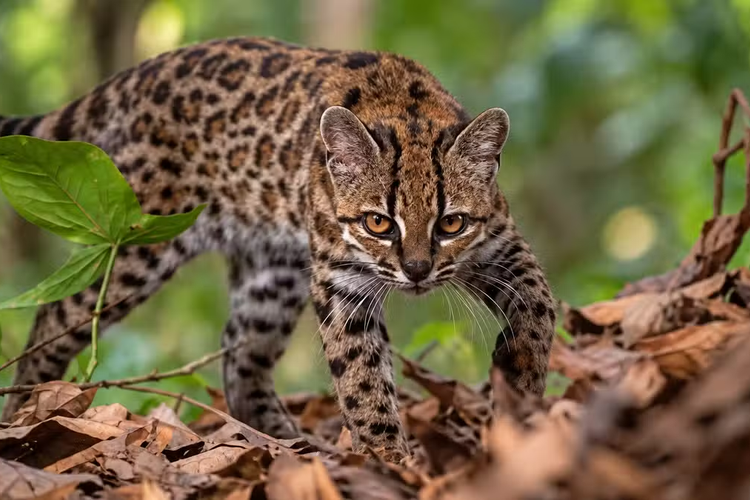
Scientists have formally identified a previously unknown wild cat species in Bolivia, marking a significant development in the study of the world’s feline species.
The small cat, known locally as Tilcayo, inhabits the cloud forests of Bolivia’s Yungas region. Researchers have named the species Leopardus tilcayo, preserving the animal’s traditional local name.
The discovery is particularly notable because it represents the first formal description and naming of a living cat species in more than a century.
Tilcayo belongs to the tiger cat group, a collection of small South American felines that can be extremely difficult to distinguish from one another. Their similar physical characteristics have historically made species identification challenging.
The newly recognized cat lives in the mountainous Yungas forest, an environment characterized by dense vegetation, frequent cloud cover and high humidity. The region provides a habitat for a wide range of wildlife.
At approximately 18 inches in length and weighing around three pounds, Leopardus tilcayo is relatively small. Its size is closer to that of a small domestic cat than many of the larger wild feline species.
Researchers described the animal as having light-brown fur marked with irregular rosettes. However, appearance alone was not enough to establish that Tilcayo represented a distinct species.
Genetic testing played a central role in confirming the discovery. Scientists analyzed genetic information and found evidence that the Bolivian animal represents a separate species within the tiger cat group.
Paola Nogales-Ascarrunz, a National Geographic Explorer and co-author of the research, was among the scientists involved in documenting the animal and its characteristics.
Study co-lead author Jonas Lescroart, an evolutionary biologist at the University of Antwerp, noted that tiger cats are considered cryptic species. This means closely related species can have highly similar appearances while remaining genetically distinct.
For decades, tiger cats were generally treated as a single species. Genetic research later raised questions about whether the group contained multiple distinct species, prompting scientists to investigate their evolutionary relationships more closely.
Despite the significance of the discovery, researchers currently have limited information about Tilcayo. Data is available from only two known living individuals, along with a relatively small collection of camera-trap observations.
Some clues about the animal’s lifestyle have emerged from field research. Remains of small rodents were found in scat samples, suggesting that rodents may be an important part of its diet.
Camera traps have also provided indications that Tilcayo may be more active during nighttime hours. However, researchers say much more observation is needed to understand the species’ behaviour, population and ecological role.
One of the known living Tilcayo cats is a 10-year-old male currently being cared for at the Senda Verde Wildlife Sanctuary. The animal had previously been kept by a local family before being transferred to the sanctuary.
The discovery also highlights how much remains to be documented in remote ecosystems. Even after centuries of scientific exploration, genetically distinct animal populations can remain overlooked when their physical characteristics closely resemble those of known species.
Researchers will need additional field studies and genetic sampling to determine how widely Leopardus tilcayo occurs in Bolivia and whether other populations exist in the Yungas forests.
The identification of Tilcayo adds a newly recognized feline to the scientific record and provides another reason for researchers to study and protect Bolivia’s cloud-forest ecosystems.
Topics #Bolivia #city magazine #Cloud Forest #Genetic Research #Leopardus tilcayo #New Species #News #Tiger Cats #Tilcayo #Trending Pakistan #Wild Cat #Wildlife Discovery #Wildlife Science #Yungas Forest