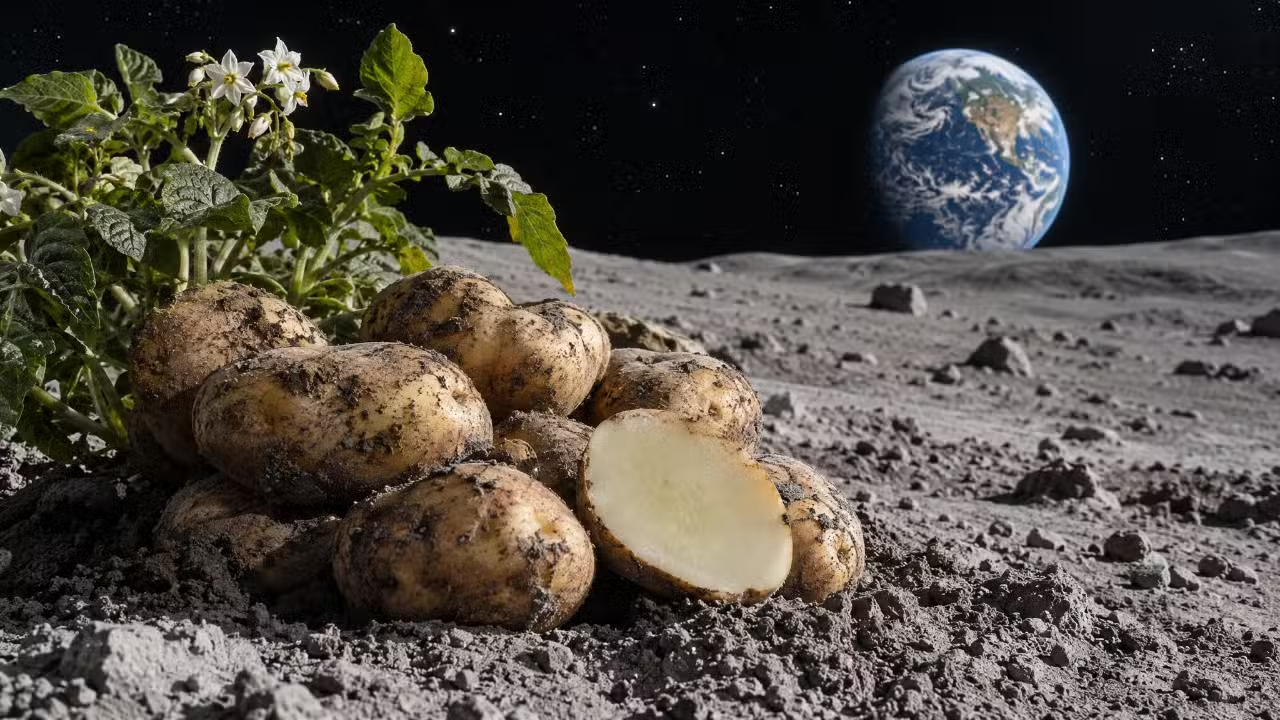
Scientists have achieved a promising breakthrough in space agriculture by successfully growing potatoes in simulated lunar soil, raising hopes that future astronauts could produce fresh food on the Moon. The research suggests that growing crops beyond Earth may become a practical part of long-term space exploration and future lunar settlements.
The experiment focused on producing nutritious potatoes that could potentially support astronauts living and working at future Moon bases. With space agencies planning increasingly ambitious lunar missions, finding reliable ways to grow food away from Earth has become an important scientific priority.
The NASA-supported research used a potato variety known as Modoc, which produces red-skinned potatoes with white flesh and is known for its relatively early maturity. Researchers selected the variety to investigate how crops might perform in soil designed to replicate the conditions found on the lunar surface.
Lunar soil, commonly known as regolith, is very different from the fertile soil found on Earth. It contains mineral particles but lacks the organic matter, microorganisms, and biological activity that normally help plants grow.
Growing food in this material presents several challenges. Scientists must consider nutrient availability, water retention, soil structure, and the possible effects of substances present in lunar regolith.
The successful potato experiment represents an encouraging step toward overcoming these obstacles. It demonstrates the potential of using lunar soil-based growing systems to support food production during future space missions.
For astronauts, producing food locally could offer several advantages. Transporting supplies from Earth is expensive, requires significant launch capacity, and becomes increasingly difficult as missions travel farther from our planet or remain in space for longer periods.
Growing crops on the Moon could eventually reduce dependence on regular supply deliveries. Freshly produced food may also provide important nutrients and improve the variety of meals available to astronauts during extended missions.
Potatoes are particularly interesting for space agriculture because they provide carbohydrates and other essential nutrients. Their ability to produce an edible crop within a relatively compact growing system makes them a potential candidate for future controlled-environment farming.
However, growing a plant successfully does not automatically mean that large-scale lunar farming is ready. Researchers must still investigate whether crops can consistently grow under lunar conditions and whether harvested food remains safe for consumption over multiple growing cycles.
Future research will also need to address the challenges of growing plants in reduced gravity, managing water supplies, providing artificial lighting, and protecting crops from radiation.
The experiment is part of a broader scientific effort to develop sustainable food-production systems for space exploration. NASA and other space agencies are investigating technologies that could help astronauts maintain longer missions without depending entirely on food transported from Earth.
As plans for future lunar exploration continue to develop, the ability to grow fresh vegetables and other crops could become an important requirement for permanent human settlements.
Although farming on the Moon remains a developing field, the successful growth of potatoes in simulated lunar soil offers an encouraging glimpse of what future space agriculture might achieve. What is currently an experimental breakthrough could eventually help astronauts produce part of their own food beyond Earth.