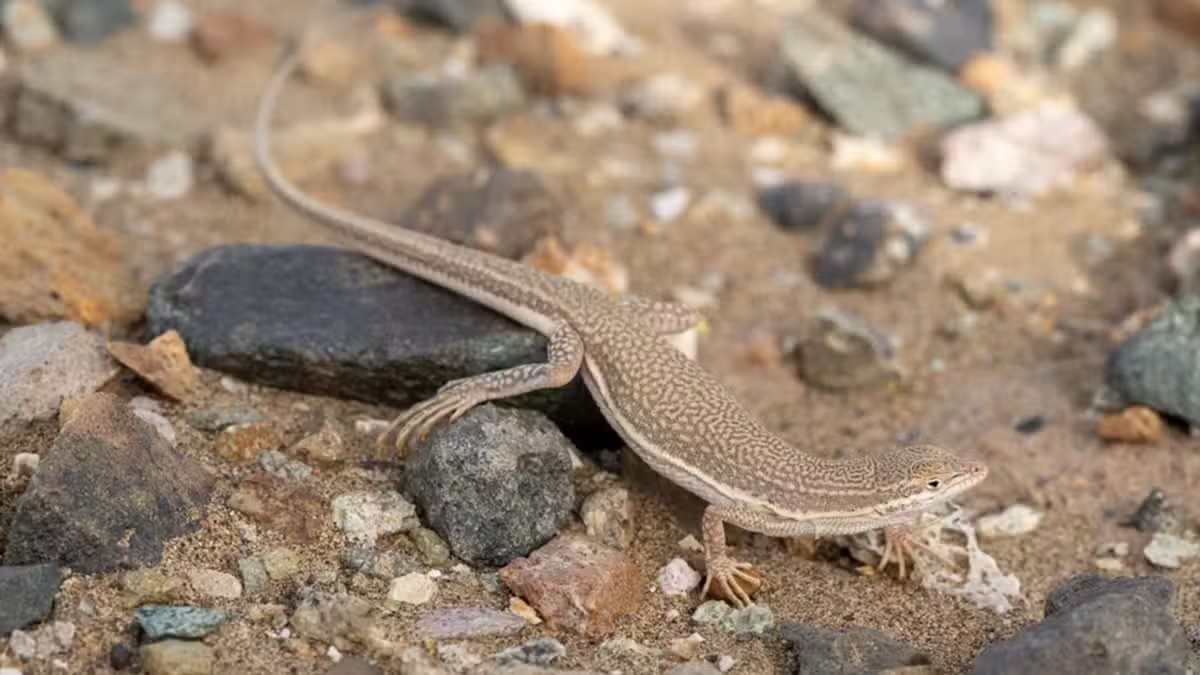
An international team of researchers has discovered a previously undocumented lizard species in Pakistan’s Balochistan province, adding to the country’s known wildlife diversity. The newly identified species, named Eremias chagaiensis, was found in the Chagai District, an area known for its dry landscapes and sandy terrain.
The discovery highlights the ecological importance of Balochistan and demonstrates that Pakistan’s diverse natural environments may still hold wildlife species that have not yet been scientifically documented.
According to researchers, the newly identified lizard was discovered on low sand dunes in Chagai District. One of its most distinctive physical features is a pattern of maze-like brown markings running across its back, which helps distinguish it from other related lizard species.
Researchers documented the species at four different locations during field surveys conducted between 2022 and 2025. These surveys provided important information about its appearance, habitat, and geographical distribution.
The lizard has a relatively small body, measuring up to 5.7 centimetres in length when its tail is excluded. Its tail can grow to more than twice the length of its body, making it a particularly noticeable feature of its physical structure.
The scientific identification of Eremias chagaiensis is an important contribution to the study of reptiles in Pakistan. Identifying previously unknown species helps researchers better understand biodiversity, wildlife distribution, and the ecological conditions that support different forms of life.
Balochistan contains a variety of natural habitats, including deserts, rocky landscapes, mountains, and sandy plains. These environments support different species of reptiles and other wildlife that have adapted to challenging climatic conditions.
The discovery in Chagai District also draws attention to the importance of conducting field research in less-explored regions. Although desert environments may appear relatively lifeless, they can support specialised wildlife with unique physical characteristics and survival adaptations.
The newly identified species’ presence at four surveyed locations provides researchers with an initial understanding of its distribution. However, further scientific investigations could help establish more information about its population, behaviour, diet, breeding patterns, and conservation requirements.
Discoveries like this are valuable because documenting a species is an important first step towards understanding its role in the local ecosystem. It can also help scientists identify environmental threats and assess whether particular habitats require additional protection.
Pakistan is home to a wide range of reptiles, birds, mammals, and other wildlife species. Continued research and biodiversity surveys are essential for documenting this natural heritage and improving scientific knowledge about the country’s ecosystems.
The identification of Eremias chagaiensis in Balochistan represents a notable development in Pakistan’s wildlife research. With its distinctive brown markings, small body, and unusually long tail, the newly discovered lizard adds another scientifically recognised species to the country’s reptile diversity.
The findings also reinforce the importance of protecting natural habitats and supporting scientific research in remote areas where undiscovered wildlife may still exist.