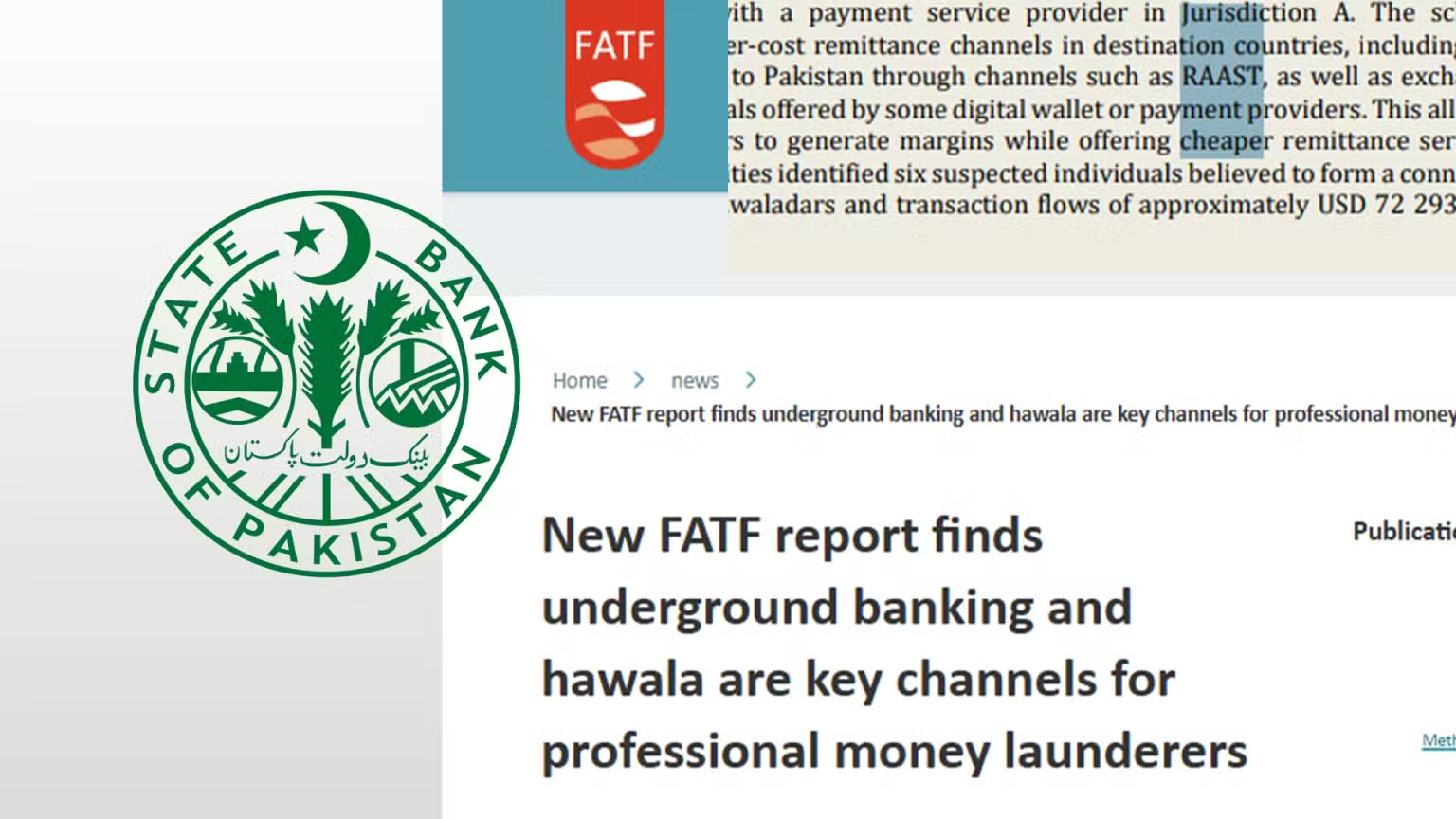
The State Bank of Pakistan (SBP) has rejected the impression that Pakistan’s instant payment system, RAAST, has been identified as a money-laundering channel by the Financial Action Task Force (FATF).
The clarification comes after references to RAAST appeared in FATF’s September 2026 report on professional money laundering, underground banking and hawala networks.
The SBP said the FATF report does not raise concerns about the integrity of RAAST as Pakistan’s instant payment infrastructure. The central bank’s position indicates that the mention of RAAST should not be interpreted as an allegation that the payment system itself facilitates illegal financial activity.
However, the FATF report does mention RAAST in the context of a specific case involving an unlicensed cross-border remittance network. The report describes how suspected hawaladars in Oman used digital payment channels and low-cost remittance services to transfer value to Pakistan.
According to the FATF report, the case involved a network advertising foreign exchange and remittance services to expatriate communities. Customers allegedly transferred money to suspected operators through cash or mobile-linked payments, while corresponding digital wallets were used in the settlement process.
The report specifically notes that lower-cost remittance channels to Pakistan, including fee-free transfers through RAAST, were exploited by the suspected hawala operators. The arrangement allowed the operators to offer cheaper remittance services while earning margins through exchange-rate differences.
This distinction is important because the FATF report focuses on the misuse of financial and payment infrastructure by criminal networks. It does not state that RAAST is inherently a money-laundering system.
FATF’s broader findings explain that underground banking and hawala networks can combine informal systems with legitimate financial infrastructure. The report says criminals may exploit banks, payment service providers, mobile wallets and other regulated platforms as part of wider money-laundering arrangements.
The report also highlights the growing digitalisation of underground banking. According to FATF, criminal networks are increasingly using electronic payment technologies, virtual assets, fintech platforms and encrypted communications to move or conceal illicit funds.
For Pakistan, the reference to RAAST highlights a broader challenge facing fast and affordable digital payment systems. As instant payments become more accessible, regulators and financial institutions must ensure that legitimate users can benefit from the technology while preventing criminals from abusing the same infrastructure.
RAAST was developed by the State Bank of Pakistan as an instant payment system designed to make digital payments faster, easier and more accessible. Its low-cost structure can support financial inclusion and provide consumers with convenient alternatives to traditional payment methods.
The FATF case therefore appears to concern the exploitation of a legitimate payment channel by an alleged illicit network rather than a finding that RAAST itself is involved in money laundering.
FATF also stresses that legitimate remittance activity should be distinguished from criminal misuse. Its report notes that underground banking and hawala-related services can serve legitimate purposes, while also warning that such channels can be exploited by professional money launderers.
The issue is particularly relevant for Pakistan because the country has a large overseas diaspora and receives substantial remittance flows. Affordable digital channels can make formal remittances more convenient, but regulators must continue strengthening monitoring and compliance mechanisms to protect the financial system.
The SBP’s rejection of the reported characterization is therefore significant for public confidence in RAAST. At the same time, the FATF reference demonstrates why payment systems, banks and financial technology providers need effective safeguards against criminal exploitation.
The key point is that the FATF report identifies the misuse of payment channels within a specific money-laundering case. It does not establish that RAAST as a system is itself a money-laundering platform.
As Pakistan expands its digital payments ecosystem, the balance between financial inclusion, low-cost remittances and strong anti-money-laundering controls is likely to remain an important issue for regulators and financial institutions.