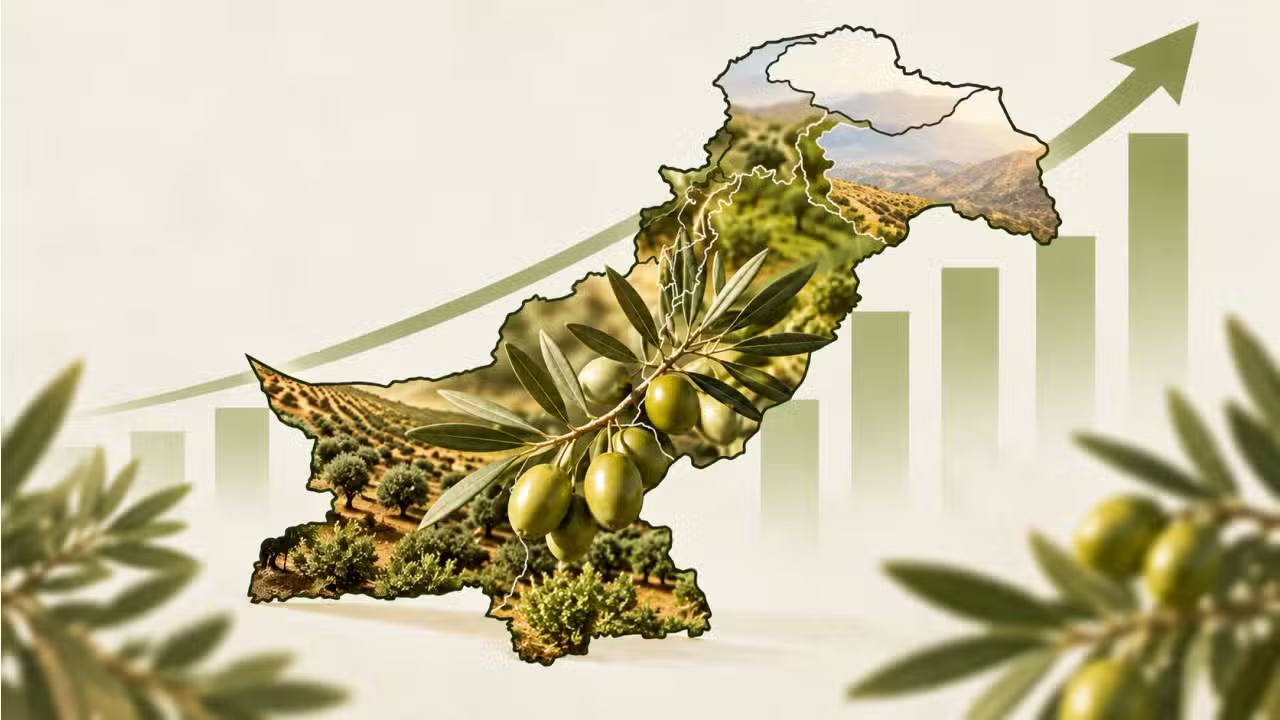
Pakistan’s domestic olive oil production is expected to reach 716 tons this year, marking another step in the country’s efforts to develop its olive cultivation industry. The projected output reflects decades of research, agricultural initiatives and efforts to encourage the commercial production of olives.
According to a government survey cited by ProPakistani, the anticipated production highlights the potential of olive farming as an emerging sector within Pakistan’s agricultural economy. However, expanding production will be only one part of the challenge, with processing facilities, market access and consumer awareness also important for the industry’s long-term growth.
Pakistan’s efforts to promote olive cultivation date back to 1986, when the Pakistan Agricultural Research Council (PARC) began collaborating with the Italian government. The initiative focused on introducing olive trees to the country and developing suitable cultivation practices for local conditions.
In the early 2000s, researchers also began exploring ways to transform wild olive species into fruit-bearing varieties. This work helped build the scientific foundation for expanding olive cultivation beyond naturally occurring wild trees and towards commercially productive orchards.
A further initiative followed a debt-swap agreement between Pakistan and Italy in 2006. The five-year project aimed to connect olive cultivation with rural economic development, offering a pathway to support agricultural communities while encouraging the production of a potentially valuable crop.
After the devolution of the Pakistan Oilseed Development Board, the project was transferred to PARC and completed in 2012. Subsequent years brought additional initiatives aimed at expanding commercial olive cultivation and strengthening Pakistan’s capacity to produce olive oil locally.
The expected output of 716 tons represents a significant milestone in the development of this sector, although production figures alone cannot determine whether the industry has reached its full potential. The next stage will depend on how effectively Pakistan can turn increased cultivation into a sustainable, commercially competitive supply chain.
One important priority is improving the infrastructure required to process olives after harvesting. Timely harvesting, modern extraction equipment, suitable storage conditions and consistent quality standards can all influence the quality of the final product.
Expanding the availability of processing facilities near growing areas could also help farmers reduce transportation challenges and handle their harvest more efficiently. Better coordination between growers, processors and distributors would support a more organised domestic olive oil market.
Another important consideration is farmer support. Training in orchard management, irrigation, pruning, pest control and harvesting techniques can help improve productivity and maintain consistent fruit quality. Access to technical guidance and reliable markets may also encourage more farmers to invest in olive cultivation.
Consumer awareness will be equally important. Olive oil competes with other cooking oils that are already widely available in Pakistan. Promoting locally produced olive oil through transparent labelling, quality assurance and effective retail distribution could help build consumer confidence and encourage demand.
The industry may also benefit from stronger branding and market development. A recognisable identity for Pakistani olive oil, supported by verified quality standards and information about its origin, could help local producers distinguish their products in a competitive marketplace.
However, higher output does not automatically guarantee lower prices, greater exports or increased profits for farmers. Those outcomes will depend on production costs, processing capacity, product quality, consumer demand and the ability of businesses to reach domestic and international buyers.
Pakistan’s olive sector has developed through decades of research and successive agricultural projects. Reaching the projected 716 tons would provide an opportunity to assess the progress made so far and identify the investments needed to sustain future growth.
The next challenge is to build on that progress by strengthening the entire value chain, from orchards and harvesting to processing, packaging and retail sales. If these areas receive sustained attention, olive cultivation could become a more established part of Pakistan’s agricultural economy and create additional opportunities for rural communities.