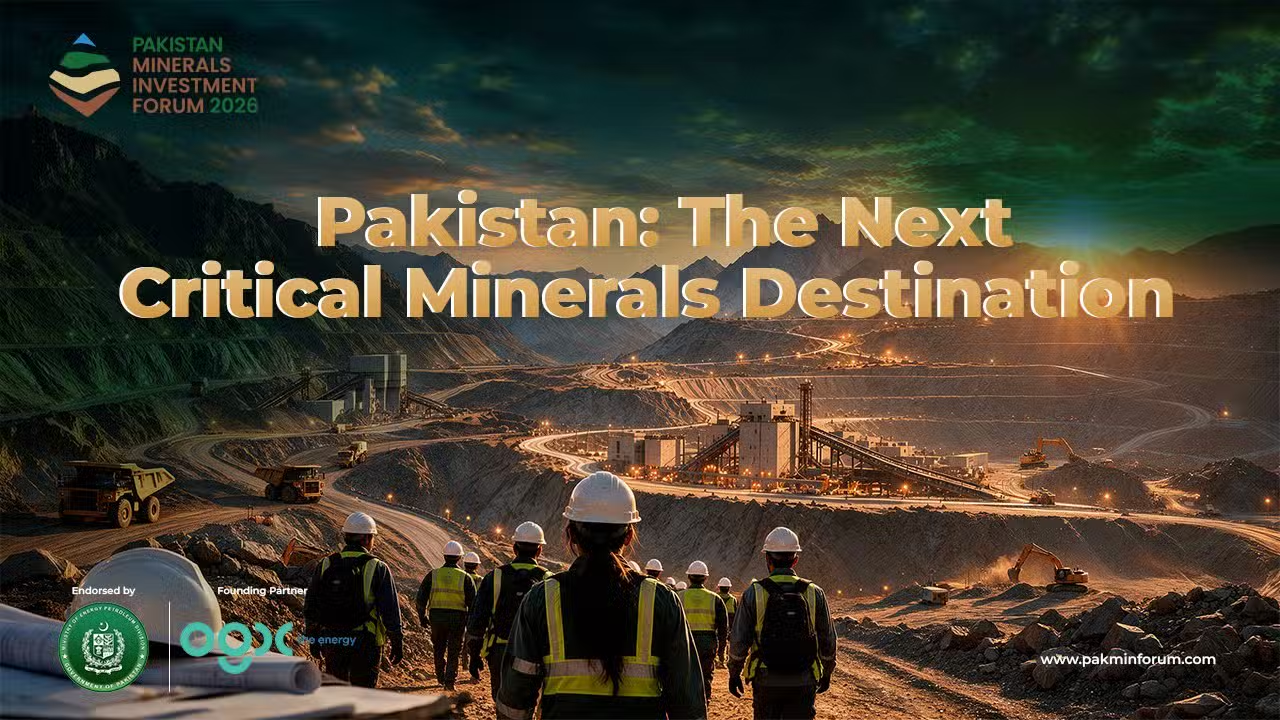
Pakistan is seeking to unlock the economic potential of its mineral resources as global demand for copper, gold, lithium, chromite, rare earth elements, and other critical minerals continues to grow. The country has an opportunity to attract international investment, expand mineral exports, create jobs, and strengthen its position in emerging global supply chains.
With extensive mineral-bearing regions and a strategic geological location, Pakistan could become a more important player in the global mining industry. However, turning this potential into sustainable economic growth will require investment, modern technology, transparent regulations, and stronger infrastructure.
According to the Institute of Cost and Management Accountants of Pakistan (ICMA), the country has 92 known minerals, of which 52 are commercially exploited. The institute has also estimated Pakistan’s mineral resources at around $8 trillion, highlighting the scale of the opportunity available to the mining sector.
Despite this potential, mining has historically contributed less than 3% to Pakistan’s gross domestic product (GDP), according to ICMA. The institute estimates that stronger governance and improved security could help increase annual mineral exports from approximately $3 billion to $8 billion.
These figures illustrate the gap between Pakistan’s geological resources and its current mining output. Expanding exploration, improving mineral processing, and developing export-ready projects could help the country capture a larger share of the value generated by its natural resources.
One of the biggest challenges is creating an environment in which large-scale mining projects can attract long-term financing. Investors typically require reliable geological data, clear licensing procedures, stable regulations, adequate transport and energy infrastructure, and confidence in security arrangements.
Environmental protection and engagement with local communities are also essential. Responsible mining practices can help reduce environmental damage while ensuring that nearby communities have opportunities to benefit from investment and employment.
Reko Diq Project Leads Pakistan’s Mining Ambitions
The Reko Diq copper and gold project in Balochistan’s Chagai district is central to Pakistan’s plans to expand its mining sector. It is widely regarded as one of the world’s largest undeveloped copper and gold deposits.
The project is operated through a joint venture in which Barrick Mining Corporation holds a 50% stake. The Balochistan government owns 25%, while three federal state-owned enterprises collectively hold the remaining 25%.
Barrick completed an updated feasibility study for Reko Diq in February 2025. The study outlined a projected mine life of 37 years and total capital investment of approximately $8.83 billion, making the project a major long-term investment opportunity for Pakistan.
Development is planned in two phases. The first phase is expected to require between $5.6 billion and $6 billion in capital investment, with initial production targeted for the end of 2028.
During Phase 1, the project is designed to process 45 million tonnes of ore annually. Planned average annual production includes approximately 240,000 tonnes of copper and 297,000 ounces of gold.
The second phase, planned for 2034, would increase processing capacity to 90 million tonnes of ore annually. During its first 10 years, this phase is projected to produce an average of 460,000 tonnes of copper and 520,000 ounces of gold each year.
The feasibility study estimates probable mineral reserves of around 3 billion tonnes, containing approximately 15 million tonnes of copper and 26 million ounces of gold. Barrick has also projected substantial long-term cash flow from the project over its operating life.
International financing institutions have shown interest in supporting the development. According to the information provided, financing commitments and approvals include support from the Asian Development Bank, the International Finance Corporation, the World Bank, and the US Export-Import Bank.
If implemented as planned, Reko Diq could support exports, employment, infrastructure development, and government revenues. However, the project’s ultimate economic contribution will depend on construction progress, operating performance, market conditions, and effective management.
Rising Global Demand Creates New Opportunities
Demand for critical minerals is increasing as countries invest in renewable energy, electric vehicles, electricity networks, advanced manufacturing, and digital infrastructure.
Copper is particularly important because it is widely used in electrical wiring, power transmission, renewable energy systems, and industrial equipment. Gold and silver also have applications in electronics, while lithium and rare earth elements are important to several clean-energy and advanced-technology supply chains.
According to projections cited in the provided material, global copper demand could reach 42.7 million tonnes annually by 2035, representing an increase of 24%. The expansion of electricity networks and data centres could add to demand for copper and other essential materials.
Governments are also seeking to diversify their mineral supply chains. Policies in the United States and European Union have placed greater emphasis on securing reliable sources of critical raw materials and reducing dependence on concentrated supply networks.
For Pakistan, these developments create an opportunity to attract investors interested in exploration, extraction, refining, and mineral processing. However, international demand alone will not guarantee commercial success. Projects must demonstrate viable deposits, competitive production costs, dependable infrastructure, and compliance with environmental standards.
Pakistan Expands International Mineral Partnerships
Pakistan has also pursued cooperation with international companies to develop its critical minerals sector. On September 8, 2025, the Frontier Works Organisation and US Strategic Metals signed memoranda of understanding covering critical minerals, rare earth elements, processing, and logistics.
The proposed cooperation aims to establish a framework for identifying minerals suitable for export and exploring opportunities for more advanced processing facilities in Pakistan.
According to the information provided, the partnership envisages an initial investment phase of approximately $500 million in the country’s critical minerals sector. The plans also include exploring opportunities for a polymetallic refinery that could produce intermediate and finished mineral products for international markets.
Such partnerships could help Pakistan move beyond exporting raw materials. Processing minerals domestically can create additional economic activity, develop technical expertise, and potentially increase the value earned from each tonne of extracted material.
Nevertheless, memoranda of understanding establish a framework for cooperation rather than guaranteeing that all proposed investments or facilities will be completed. Progress will depend on commercial feasibility, financing, regulatory approvals, and implementation.
PMIF26 Aims to Attract Global Mining Investors
The Pakistan Minerals Investment Forum has emerged as a government platform for connecting the country’s mineral sector with international investors, mining companies, financial institutions, and technology providers.
The previous edition, PMIF25, attracted approximately 5,000 delegates from more than 50 countries and included the signing of 16 memoranda of understanding, according to the supplied information.
The 2026 edition, known as PMIF26, was originally scheduled for April 8–9 at Islamabad’s Jinnah Convention Centre. It was subsequently rescheduled for November 12–13, 2026, at the same venue.
The forum is intended to promote Pakistan’s mineral potential and encourage investment across exploration, extraction, processing, and related services. It also provides an opportunity for government representatives and industry participants to discuss regulatory challenges, infrastructure requirements, and sustainable mining practices.
For investors, such events can help identify potential partners and projects. For Pakistan, the wider objective is to turn interest in mineral resources into commercially viable operations that support exports, employment, and industrial development.
Can Pakistan Become a Major Critical Minerals Hub?
Pakistan’s prospects will depend on more than the size of its mineral reserves. The country needs a complete mining ecosystem that supports exploration, financing, extraction, processing, transportation, and access to international markets.
Clear regulations, reliable geological information, effective security arrangements, and transparent contracts can help reduce investment risks. Investment in roads, railways, electricity, water infrastructure, and skilled workers will also be important for developing projects in remote mineral-rich regions.
Equally important is ensuring that mining benefits local communities and protects the environment. Responsible water management, pollution controls, land rehabilitation, and meaningful community consultation should remain central to project planning.
Pakistan has significant opportunities to develop its mineral economy, with Reko Diq serving as a prominent example of the scale of investment being considered. International partnerships and investment forums may help expand that momentum across other mineral projects.
The next challenge is execution. If Pakistan can translate geological potential into productive mines, domestic processing facilities, and reliable exports, critical minerals could become a more important source of economic growth and foreign exchange. Sustained investment, strong governance, and responsible development will determine whether that opportunity becomes a lasting economic advantage.