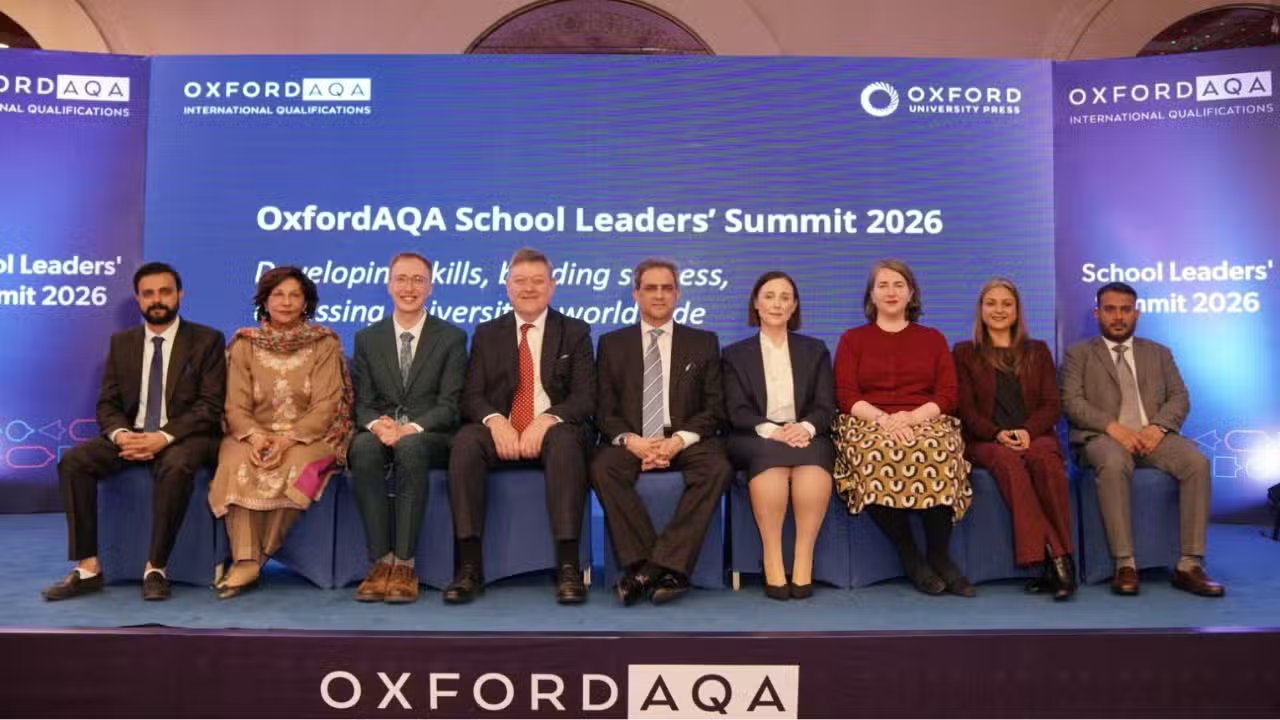
OxfordAQA, a partnership between Oxford University Press and AQA, the United Kingdom’s largest provider of GCSEs and A-levels, brought together education leaders, policymakers, and practitioners at the OxfordAQA School Leaders’ Summit 2026 in Islamabad. The event focused on rethinking assessment and learning through competence-based education and future-ready skills to better prepare students for the demands of a rapidly evolving world.
The summit gathered national and international experts to examine how traditional assessment systems can be transformed to emphasize skills, application, and critical thinking. Discussions centered on aligning education with real-world needs while maintaining academic rigor and integrity.
Arshad Saeed Husain, Managing Director of Oxford University Press Pakistan, delivered a keynote address highlighting the urgency of shifting away from rote memorization. He emphasized that competence-based education places learners at the center of the system by prioritizing understanding, practical application, and skill development. He noted that such an approach ensures education remains relevant to both national priorities and global opportunities.
Dr. Shoaiba Mansoor, Deputy Education Advisor at the Ministry of Federal Education and Professional Training, delivered a keynote on the role of skills in assessment. She stressed that modern assessment must go beyond testing memory and instead evaluate how students think, reason, and apply knowledge. She highlighted the critical role of school leaders in ensuring assessments prepare learners not only for examinations, but also for higher education, employment, and lifelong learning.
Andrew Coombe, Managing Director of OxfordAQA, outlined the organization’s global mission and reaffirmed its commitment to Pakistan. He stated that OxfordAQA is focused on designing assessments that are fair, rigorous, and future-focused, enabling learners to develop skills that truly matter in today’s world.
The role of technology in education was addressed by Dr. Alexandra Tomescu, Product Specialist for Generative AI and Machine Learning at Oxford University Press. She explained that responsible use of artificial intelligence can enhance learning experiences, support teachers, and strengthen assessment design while preserving educational integrity.
Andrew Coombe also shared global case studies demonstrating the impact of the OxfordAQA approach worldwide. This was complemented by Salma Adil, Director of OxfordAQA Pakistan, who highlighted local initiatives supporting schools in adopting assessment practices that build confidence, critical thinking, and transferable skills among students.
A panel discussion titled Empowering Students with Future-Focused Skills featured expert perspectives on preparing learners for a changing global landscape. Moderated by Neda Mulji, Senior Manager for Professional Development at Oxford University Press Pakistan, the session concluded with an interactive exchange with participants.
The programme also included a presentation on the Oxford International Programme by Matt MacGregor, outlining education pathways that support learners from early years through secondary education. The summit concluded with closing remarks reaffirming OxfordAQA’s long-term commitment to collaborating with educators and policymakers to shape the future of education in Pakistan.